electronics
Solenoid Inductor Calculator
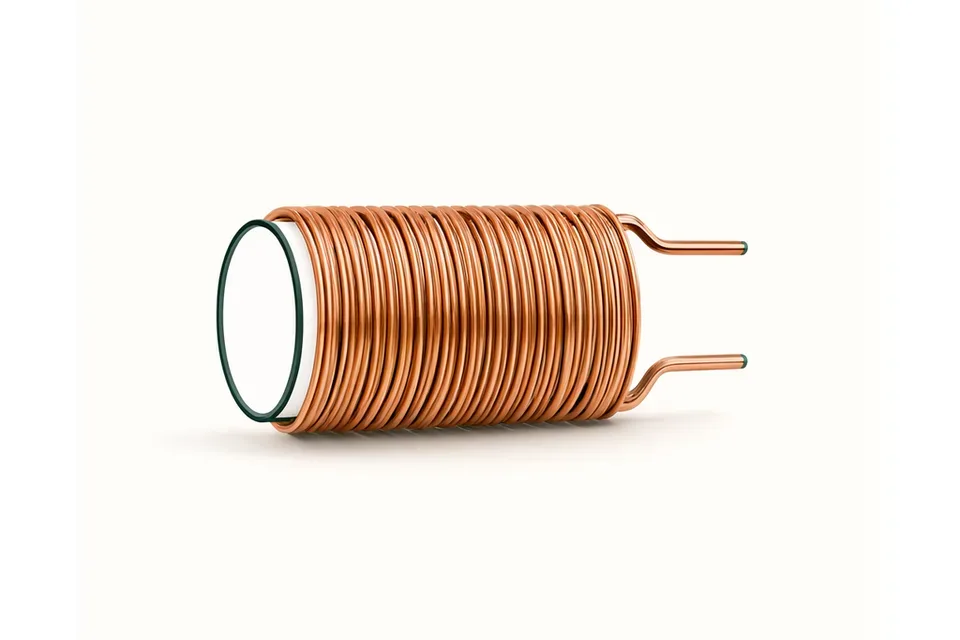
Estimate an air-core solenoid's inductance both ways — single-layer (Wheeler/Nagaoka) or multi-layer — from turns, diameter and winding length, or the turns needed for a target value.
Coil dimensions
e.g. 50, 100 or 200
e.g. 25.4, 50.8 or 10 - read in the selected unit
e.g. 25.4, 50.8 or 2 - read in the selected unit
Wheeler approximations, evaluated in inches and microhenries: L(uH) = r^2 * N^2 / (9r + 10l) for single-layer and L(uH) = 0.8 * a^2 * N^2 / (6a + 9b + 10c) for multi-layer, where r/a are the coil radius / mean radius, l/b the winding length and c the winding depth - published estimates, a few percent for typical air-core geometries. The entered number is always read in the selected unit - switching the unit reinterprets the same number, it never rewrites it.
Inductance
Enter the turns, coil diameter and winding length - the Wheeler single-layer estimate solves live as you type.
Before you rely on this
- Wheeler/Nagaoka single-layer L(uH) = r^2 * N^2 / (9r + 10l) and Wheeler multi-layer L(uH) = 0.8 * a^2 * N^2 / (6a + 9b + 10c), r/l/a/b/c in inches - published approximations, typically a few percent for ordinary air-core geometries and worse for extreme length/diameter ratios, very dense windings or thick builds. Treat every result as an estimate, not engineering advice.
- The accurate upgrade path is the Maxwell filament / partial-inductance method (summing each turn filament, as Coil32 does) - named here, out of scope for this tool.
- Air-core model only: no ferrite, powdered-iron or other core material and no permeability - a cored coil is a different calculation.
- Named out of scope: self-capacitance and self-resonant frequency, shielding and coupling to nearby conductors, the proximity effect between adjacent turns, wire gauge, current capacity, DC resistance and insulation build.
- The multi-layer formula treats the winding as a smooth sheet across its radial depth - real layer insulation, spacing irregularities and wire diameter all shift the true value; depth is entered directly (about layers x wire diameter).
- Geometry is checked, never clamped: coil diameter, winding length and (multi-layer) winding depth must be positive, turns at least 1, target above 0. An unreachable inverse target is reported as such, not as a nonsense turn count.
- The inverse solve is bounded at 10000 turns - denser coils are beyond this estimate.
- Units come from the pickers - enter plain numbers; the entered number is always read in the selected unit.
Enter the turns and the coil diameter and winding length to see the inductance.