electronics
Yagi Element Suggester
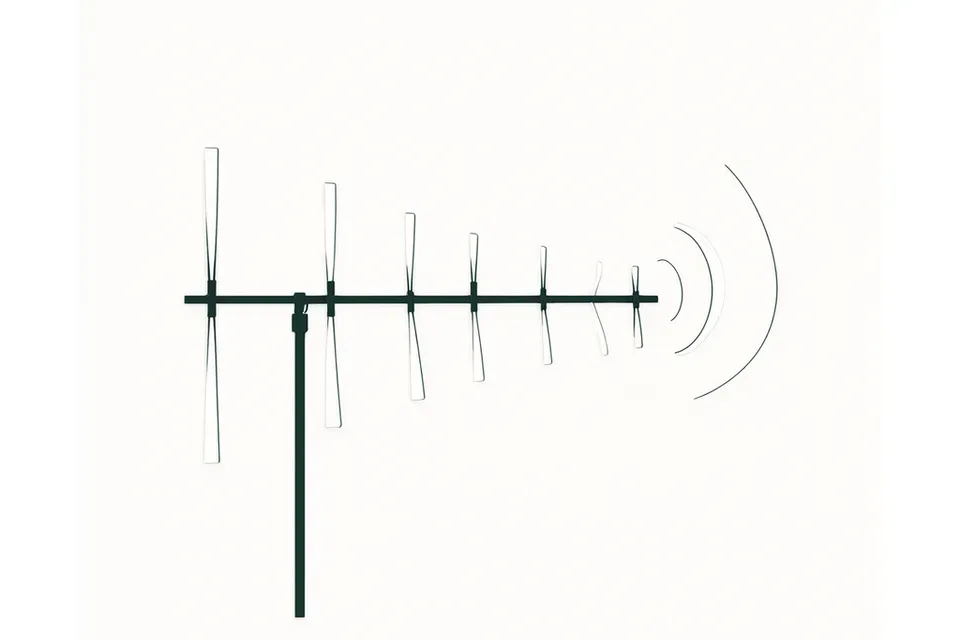
Starting dimensions for a simple Yagi beam — reflector, driven element and director lengths plus boom-spacing rules of thumb from a target frequency — labelled a starting point, not a tuned design.
Frequency
e.g. 146, 146MHz or 1.296GHz - a bare number is MHz.
Common bands - approximate centres
Approximate band centres only - allocations vary by region.
Every number is a labelled starting cut for a basic 3-element Yagi - real designs need antenna modelling and analyzer trimming. See the limits below the results.
Starting cuts
Enter a frequency - reflector, driven and director starting cuts plus boom spacing solve live as you type. A bare number is MHz; suffixes like kHz, MHz and GHz convert automatically. The usable band is 100 kHz to 10 GHz.
Before you rely on this
- Every number is a labelled starting cut, not a tuned design - real Yagi design is iterative antenna modelling (NEC, 4nec2, EZNEC, MMANA or similar).
- The fractions (reflector 0.51, driven 0.48, director 0.44 lambda) and spacings (0.20 and 0.15 lambda) are rules of thumb for a basic 3-element array - published designs vary with element diameter, boom and target pattern.
- Element diameter, boom and mounting hardware, antenna height and nearby conductors all shift resonance - thicker elements resonate slightly shorter than these cuts suggest.
- No gain, pattern or front-to-back claims - this tool sizes starting cuts only and predicts no performance.
- Feed impedance shown is context, not a promise: a parasitic array's driven element typically lands well below a lone dipole's ~73 ohm and needs matching - the final match is set with an antenna analyzer or tuner; SWR is never guaranteed.
- Frequency band is 100 kHz to 10 GHz - outside that range a practical Yagi estimate is not meaningful.
- Cut slightly long, then trim with an antenna analyzer or SWR meter while watching the match - resonance moves as you prune.
- Estimates for hobby builds - no safety or licensing guidance; keep antennas clear of power lines and follow local rules.
Enter a frequency to see Yagi starting cuts.