nautical
Beaufort Scale
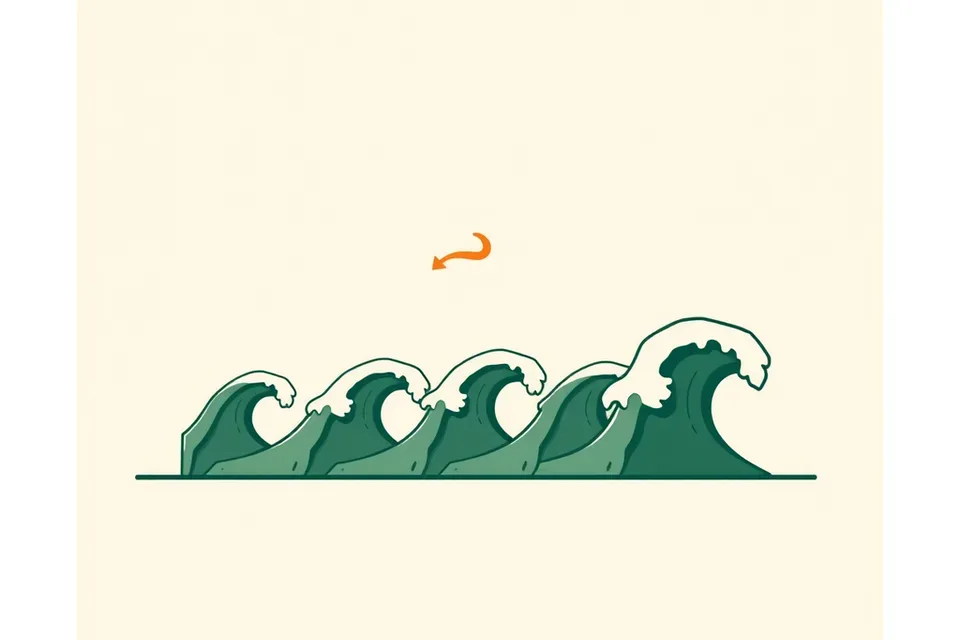
Look up the Beaufort wind force scale two ways — pick a force 0–12 to see its knot, km/h and mph ranges with the sea-state description and typical open-ocean wave height, or enter a wind speed in any of those units to find the matching force. The complete 13-row reference table is always on the page.
Look up the scale
Pick a force 0–12 to see its full row — name, every unit range, sea state and wave height.
Beaufort is a descriptive estimating scale — match observed conditions to a force, or read a measured speed onto the scale.
Result
Pick a force 0–12 to see its full row.
The Beaufort scale — forces 0 to 12
The complete reference table. Beaufort is a descriptive estimating scale, not an instrument — force numbers come from matching observed sea and land conditions to a wind speed.
| Force | Name | Wind (kn) | Wind (km/h) | Wind (mph) | Waves (open sea, approx) | Sea state & description |
|---|---|---|---|---|---|---|
| 0 | Calm | <1 | <1.9 | <1.2 | 0 m | Smoke rises vertically; sea like a mirror. |
| 1 | Light air | 1–3 | 1.9–5.6 | 1.2–3.5 | 0–0.3 m | Direction shown by smoke drift but not by wind vanes; sea ripples like fish scales, without foam crests. |
| 2 | Light breeze | 4–6 | 7.4–11.1 | 4.6–6.9 | 0.3–0.6 m | Wind felt on face, leaves rustle, wind vane moved; small wavelets, crests glassy but not breaking. |
| 3 | Gentle breeze | 7–10 | 13.0–18.5 | 8.1–11.5 | 0.6–1.2 m | Leaves and small twigs in constant motion, light flags extended; large wavelets, crests begin to break. |
| 4 | Moderate breeze | 11–16 | 20.4–29.6 | 12.7–18.4 | 1–2 m | Dust and loose paper raised, small branches moved; small waves becoming longer, fairly frequent white horses. |
| 5 | Fresh breeze | 17–21 | 31.5–38.9 | 19.6–24.2 | 1.5–2.5 m | Small trees in leaf begin to sway; moderate waves of long form, many white horses, chance of spray. |
| 6 | Strong breeze | 22–27 | 40.7–50.0 | 25.3–31.1 | 2–3 m | Large branches in motion, umbrellas used with difficulty; large waves, white foam crests extensive, some spray. |
| 7 | Near gale | 28–33 | 51.9–61.1 | 32.2–38.0 | 3–4 m | Whole trees in motion, difficult to walk against the wind; sea heaps up, foam blown in streaks, spindrift seen. |
| 8 | Gale | 34–40 | 63.0–74.1 | 39.1–46.0 | 4–5.5 m | Twigs break off trees, progress generally impeded; moderately high waves, crests break into spindrift. |
| 9 | Strong gale | 41–47 | 75.9–87.0 | 47.2–54.1 | 5.5–7.5 m | Slight structural damage (chimney pots, slates removed); high waves, dense foam streaks, sea begins to roll. |
| 10 | Storm | 48–55 | 88.9–101.9 | 55.2–63.3 | 7–10 m | Trees uprooted, considerable structural damage; very high waves, sea surface takes on a white appearance. |
| 11 | Violent storm | 56–63 | 103.7–116.7 | 64.4–72.5 | 9–12.5 m | Widespread damage; exceptionally high waves, sea covered with long white patches of foam. |
| 12 | Hurricane | ≥64 | ≥118.5 | ≥73.6 | ≥14 m | Devastation; air filled with foam and spray, sea completely white with driving spray. |
Boundary rule: each force owns speeds from its printed lower bound up to the next force’s — a speed between two printed ranges takes the lower-numbered force. km/h and mph are the knot bounds × 1.852 and × 1.15078, shown to one decimal.
Before you rely on this
- Beaufort is a descriptive estimating scale, not an instrument — force numbers come from matching observed sea and land conditions to a wind speed, so real conditions vary with fetch, duration and local seas.
- Classification is always by knots at the printed lower bounds (1, 4, 7, 11, 17, 22, 28, 34, 41, 48, 56, 64 kn); a speed between two printed ranges takes the lower-numbered force.
- km/h and mph columns are this table’s knot bounds × 1.852 and × 1.15078, shown to one decimal — printed charts round the same factors to whole numbers differently.
- Wave heights are typical open-ocean values, not shore readings — they vary with fetch and sea state; do not use them for navigation or small-craft decisions.
- The scale tops out at Force 12 — every speed of 64 kn and above reads hurricane force.
- For reference and learning — verify wind and sea conditions against official forecasts, charts and Notices to Mariners.
Pick a force 0–12 to see its full row.