calculators
Quadratic Solver
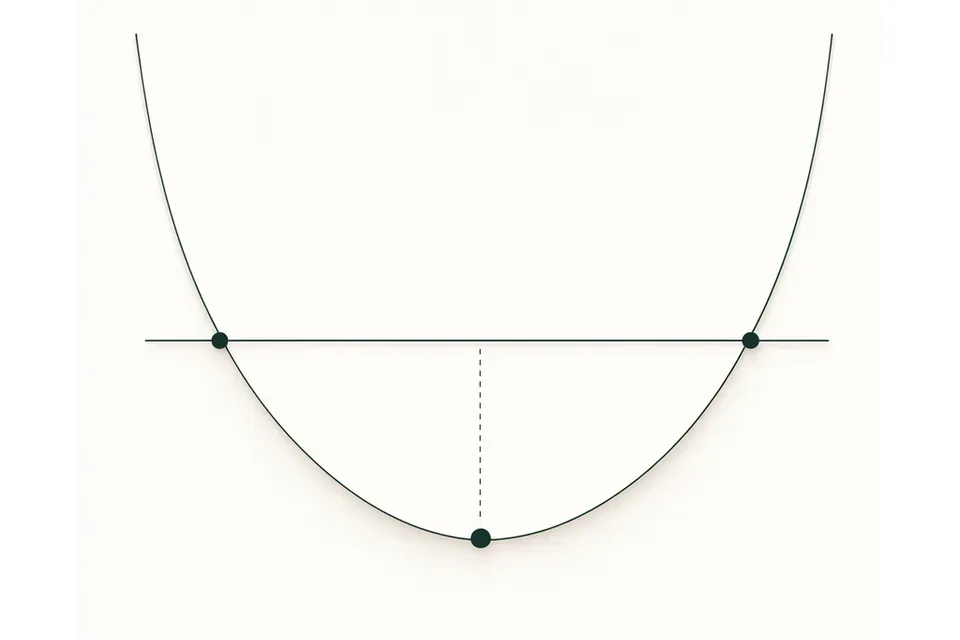
Solve ax^2 + bx + c = 0 live: enter coefficients a, b and c and get the discriminant, the roots (two real, one repeated, or a complex pair labelled 'complex - no real solution'), the vertex and the axis of symmetry, with the formula steps shown. a = 0 falls back to a stated linear solve; a = b = c = 0 is rejected.
Coefficients
e.g. 1, -2 or 0.5
e.g. -5, 3 or 0
e.g. 6, -1 or 0
a multiplies x^2, b multiplies x and c is the constant - enter plain numbers like 1, -5 or 0.5. Signs are allowed; setting a to 0 turns the equation into a linear one.
Solution
Enter all three coefficients a, b and c to solve ax^2 + bx + c = 0. Try the example: x^2 - 5x + 6 has roots 2 and 3.
How this solver works
- Solves ax^2 + bx + c = 0 for plain-decimal coefficients - discriminant, roots (real or complex), vertex and axis of symmetry with the formula steps shown. It is not a graphing tool and does not parse equations typed as text.
- a = 0 falls back to the linear equation bx + c = 0 (one solution x = -c/b). a = 0 with b = 0 and c != 0 has no solution; a = b = c = 0 is rejected because 0 = 0 is true for every x.
- Complex roots are shown as p +/- i*q and labelled "complex - no real solution" - never dropped or replaced by a real guess.
- Roots use the numerically stable quadratic form (q = -0.5*(b +/- sqrt(D)); x = q/a and x = c/q) so cancelling roots stay accurate. Coefficients are scaled to unit range internally, and a discriminant within float precision of zero is treated as a repeated root with a note.
- Display is 6 or 12 significant digits (Compact/Precise); the underlying values are never rounded. Results are for learning and checking work - estimates, not engineering-grade computation.
Enter all three coefficients a, b and c to solve.